Introduction: Why Trainers Leave Money on the Table
Most personal trainers worldwide still use the hourly payment model - simple, understandable, but increasingly suboptimal. Research from 2025 shows that the fitness industry is undergoing a global transformation toward value-based pricing, where client value - not trainer time - determines the price.
The profit difference? Enormous. Trainers using value-based pricing report predictable monthly income, higher client retention, and better profit margins - all with the same or fewer working hours.
This article is a comprehensive guide based on data from Health & Fitness Association 2025 Benchmarking Report, pricing psychology research, and real case studies from US and European markets. We'll analyze:
- Exact comparison of pricing models with ROI calculations
- Pricing psychology and how to use it to increase conversion by 28%
- Specific examples of packages and pricing structures from real studios
- Industry benchmarks - how much trainers earn in different markets
- Most common pricing mistakes and how to avoid them
Hourly Model: Traditional But Limiting
How Hourly Payment Works
The hourly model is simple exchange: 1 hour of training = X dollars. The trainer sells their time in one-hour blocks, and the client pays per session or buys hour packages.
Example: Trainer Mark in Chicago charges $35 per 1-on-1 session. Conducts 20 sessions weekly = $2,800 monthly revenue.
Advantages of Hourly Model
- Simplicity - easy for clients to understand
- Flexibility - clients pay only for used sessions
- Immediate payment - cash flow after each session
- Easy comparison - clients can compare rates between trainers
Limitations of Hourly Model
1. Physical Limit = Earnings Ceiling
A day has 24 hours. Even the most efficient trainer won't conduct more than 25-30 sessions weekly (without burnout). This creates a hard earnings ceiling.
Maximum earnings calculation:
- 25 sessions/week × $35 = $875/week
- × 4 weeks = $3,500/month (before costs)
To earn more, you must raise rates (difficult without offer differentiation) or work more (leads to burnout).
2. Unpredictable Income
Hourly model generates variable revenue:
- Canceled sessions = no income
- Vacation/holiday season = 20-40% drops
- Trainer illness = zero income
Cash flow research in fitness shows hourly trainers experience 35% higher revenue variability than those on monthly packages.
3. Clients "Bargain Shopping"
When competing only on hourly price, you attract clients seeking the cheapest option. Research shows that clients choosing solely based on price have 47% higher churn rate than those focused on value.
4. No Long-Term Commitment
Per-session payment creates no obligation. Client can disappear after 2-3 workouts without consequences. This kills:
- Ability to plan long-term transformations
- Revenue predictability
- Client motivation for consistency
Market Benchmarks - Hourly Model
According to Institute of Personal Trainers Pricing Guide 2025:
Hourly Rates in USA (2025):
- Beginner trainers: $50-$70/hour
- Mid-level (2-5 years experience): $70-$100/hour
- Experts/Specialists: $100-$200+/hour
Geographic Differences in USA:
- Urban (NYC, LA, SF): $80-$150/hour
- Suburban: $60-$100/hour
- Rural: $40-$70/hour
Value-Based Model: Pay for Results, Not Time
What Is Value-Based Pricing?
Value-based pricing is a pricing strategy where price reflects result value for client, not hours spent training. Instead of "$35 per session", you sell "12-week body transformation for $840".
Pricing psychology research shows that clients are willing to pay 2-3× more for a program with clear goal and deadline than for "training hours".
Main Value-Based Pricing Models in Fitness
1. Session Packages (Package Deals)
Client buys specific number of sessions upfront, often with discount for larger package.
Example Structure:
- 10 sessions: $330 ($33/session, baseline price)
- 20 sessions: $600 ($30/session, -9% discount)
- 30 sessions: $840 ($28/session, -15% discount)
Advantages:
- Upfront payment improves cash flow
- Commitment - client has "prepaid" sessions, higher attendance
- Lower revenue variability
Disadvantages:
- Client may leave after using package
- Still focusing on "hours", not results
2. Monthly Subscriptions (Monthly Recurring Revenue)
Client pays fixed amount monthly for specified services. Most predictable model for trainer.
Example Structure:
- Basic: $185/month - 2 sessions weekly (8/month)
- Standard: $280/month - 3 sessions weekly (12/month)
- Premium: $420/month - unlimited sessions + nutrition consultations
Advantages:
- Predictable MRR (Monthly Recurring Revenue)
- Automatic renewals = lower churn
- Research shows subscription models have 40% higher retention than per-session payment
Disadvantages:
- Requires client trust (binding contracts)
- Managing canceled sessions (rollover policy)
3. Transformation Programs (Outcome-Based Packages)
Highest form of value-based pricing - you sell specific result in defined time.
Example - "12-Week Body Transformation":
- Price: $1,120 ($93/week)
- What's included:
- 24 training sessions (2×/week)
- Custom training + meal plan
- Weekly check-ins and accountability
- Initial + progress measurements
- Private Facebook group support
- 90-day post-program email support
Value Proposition: You're not buying "hours" - you're buying "18-26 lb weight loss and muscle gain".
Advantages:
- Highest perceived value - clients pay for outcome
- Allows premium pricing (client ROI is clear)
- 28% higher conversion than single pricing structure
Disadvantages:
- Requires strong brand positioning
- Must deliver results (reputation at stake)
4. Tiered Pricing (Service Levels)
Offer 3-4 tiers of packages with different service scope and prices.
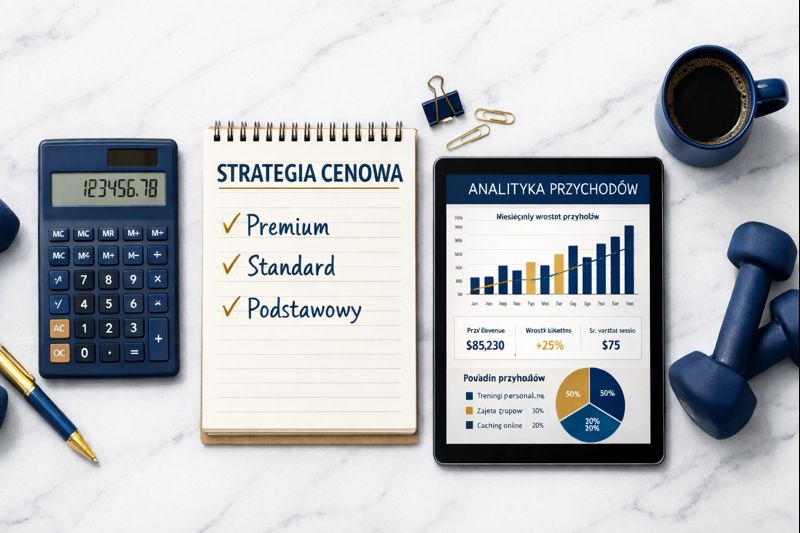
Example 3-Tier Structure:
| Tier | Price/Month | What's Included |
|---|---|---|
| Bronze | $140 | 1 session/week + email support |
| Silver | $280 | 2 sessions/week + meal plan + app access |
| Gold | $560 | unlimited sessions + nutrition + supplements + priority scheduling |
Multi-Tier Pricing Psychology:
Conversion optimization research shows anchoring effect:
- With only 1 price: client compares you to competition
- With 3 prices: client compares your options to each other
- 85% of clients choose middle option (Silver) when well-designed
3-Tier Design Principle:
- Bronze: basic level, low margin (customer acquisition tool)
- Silver: your target - 60-70% margin, highest volume
- Gold: premium, for 10-15% of clients, highest margin
Market Benchmarks - Value-Based Models
Data from 2025 Fitness Benchmarking Report:
Monthly Recurring Revenue Per Client:
- Entry-level ($150-$250/month): Trainers earn ~$2,500-$4,000/month with 15-20 clients
- Mid-tier ($250-$400/month): Trainers earn ~$5,000-$8,000/month with 20-25 clients
- Premium ($400-$500+/month): Trainers earn ~$10,000-$15,000/month with 25-30 clients
Online Coaching Packages (USA, 2025):
- Basic (workout plans only): $50-$100/month
- Standard (plans + check-ins): $100-$200/month
- Premium (full coaching): $200-$400+/month
Semi-Private Training:
- $45/session per client × 3 clients = $135/hour trainer revenue
- 15 semi-private sessions/week = $2,025/week = $8,100/month
Group Training:
- $25/class per person × 10 clients = $250/class
- 4 classes/week = $1,000/week = $4,000/month (from 4 hours work)
ROI Comparison: Hourly Rate vs Value-Based Pricing
Case Study 1: Trainer Anna - Hourly Rate Model
Profile:
- Experience: 3 years
- Location: Austin, TX
- Rate: $35/session
- Sessions weekly: 22
Monthly Revenue:
22 sessions × 4 weeks × $35 = $3,080
Costs:
- Studio rental: $585
- Liability insurance: $35
- Marketing: $115
- Software (calendar, payments): $45
- Total costs: $780
Net profit: $3,080 - $780 = $2,300
Profit margin: 74.6%
Problems:
- Maximum capacity (22 sessions/week is physical limit)
- To earn more, must raise rate (risk losing clients)
- Variable income (illness = zero income)
- High burnout risk
Case Study 2: Trainer Michael - Value-Based Model (3-Tier)
Profile:
- Experience: 3 years (same as Anna)
- Location: Austin, TX
- Model: Tiered monthly packages
Pricing Structure:
- Bronze (1×/week): $165/month → 6 clients = $990
- Silver (2×/week): $280/month → 12 clients = $3,360
- Gold (3×/week + extras): $465/month → 3 clients = $1,395
Total Clients: 21 (vs Anna's 22)
Monthly Recurring Revenue: $5,745
Actual Work Hours Weekly:
- Bronze: 6 clients × 1 session = 6 hours
- Silver: 12 clients × 2 sessions = 24 hours
- Gold: 3 clients × 3 sessions = 9 hours
- Total: 39 hours/week (training time)
Wait - that's more hours than Anna (22 vs 39)? NO - because Michael uses semi-private model for Bronze and Silver:
Adjusted Structure:
- Bronze: group sessions (2-3 clients per slot)
- Silver: semi-private (2 clients per slot)
- Gold: 1-on-1 premium
Actual Slots Weekly: ~25 (similar to Anna)
Costs: (identical to Anna)
$780
Net Profit: $5,745 - $780 = $4,965
Profit Margin: 86.4%
ROI Comparison:
- Michael earns 116% more than Anna ($4,965 vs $2,300)
- Works similar hours (25 slots vs 22 sessions)
- Has predictable monthly income (recurring)
- Higher margin (86.4% vs 74.6%)
Why Value-Based Pricing Wins?
- Price Differentiation - Different clients pay different prices for different value
- Upsell Opportunities - Bronze clients upgrade to Silver (30% rate in fitness)
- Commitment - Monthly contracts = lower churn (40% higher retention)
- Scalability - Semi-private model allows serving more clients without more hours
Pricing Psychology: How to Increase Conversion by 28%
1. Anchoring Effect
Pricing psychology research shows: the first price clients see becomes an "anchor" for all subsequent value assessments.
Application:
When presenting offer, always start with most expensive option (even if you know most will choose mid-tier).
Example:
❌ Wrong:
- Bronze: $165
- Silver: $280
- Gold: $465
✅ Right:
- Gold: $465 ← anchor (present FIRST)
- Silver: $280 ← suddenly feels reasonable
- Bronze: $165 ← feels like a bargain
Effect: Silver at $280 seems like "good price" in context of Gold at $465.
2. Prestige Pricing Effect
Prestige pricing research shows: higher price = higher perceived quality in client's mind.
Case Study from Fitness:
Trainer raised rate from $75 to $125/session. Result?
- Lost 20% of current clients (price-sensitive)
- Gained 40% new clients (seeking quality)
- Net revenue increased 30% with same hours
When to Use Prestige Pricing:
- Have unique specialization (rehab, senior training, sport-specific)
- Brand positioning as "premium" (certifications, education, results)
- Targeting affluent demographics (executive clients, high-income areas)
Warning: Prestige pricing requires support - must deliver exceptional value.
3. 3-Option Effect (Goldilocks Effect)
Conversion optimization research shows: people choose middle option in 85% of cases when given 3 choices.
Design Principle:
- Option 1 (Bronze): Sufficient but consciously "incomplete"
- Option 2 (Silver): BEST VALUE - your goal, 60-70% of clients
- Option 3 (Gold): Premium, for 10-15% of clients
Tactical Pricing:
- Bronze: $165 (low margin, acquisition tool)
- Silver: $280 (+70% vs Bronze - feels premium but accessible)
- Gold: $465 (+66% vs Silver - anchor, premium positioning)
Mistake: Too good Bronze - if Bronze offers 90% of Silver value at 60% price, everyone chooses Bronze.
4. Charm Pricing (Prices Ending in 9/7)
Pricing psychology research shows: prices ending in 9 or 7 increase conversion by 8-12%.
Examples:
- ❌ $280 → ✅ $277 or $279
- ❌ $465 → ✅ $464 or $469
Psychology: "$277" is perceived as "in the 200s", not "300" - feels cheaper.
When to Use:
- Mid-market positioning
- Competitive markets
When NOT to Use:
- Premium/luxury positioning (use round numbers: $500, $800 - conveys quality, not deal)
5. Price Framing: Daily Costs
Instead of "$280/month", present as "$9.33 daily" - suddenly feels affordable.
Example Offer Presentation:
"Silver Program is only $9.33 daily - less than coffee and lunch. For that you gain transformation, health, and energy for life."
Psychology: Daily breakdown minimizes price shock, emphasizes value vs alternative spending.
5 Most Common Pricing Mistakes (And How to Avoid Them)
Mistake #1: Underpricing - Race to the Bottom
Symptom: "I'll lower my rate to attract more clients"
Research shows: price-sensitive clients have 47% higher churn and 60% more complaints.
Case Study:
Trainer lowered rate from $35 to $23. Result?
- Revenue dropped 34%
- Attracted "bargain hunter" clients
- More cancellations and no-shows
- Reputation as "cheap trainer" (hard to raise prices later)
Solution:
Compete on VALUE, not price. Invest in:
- Specializations (certifications)
- Client results (testimonials, before/after)
- Premium experience (studio quality, customer service)
Raise prices 20-30% and use that revenue for better marketing instead of competing on price.
Mistake #2: No Market Research - "Finger in the Air" Pricing
Symptom: "I set $28 because it sounds reasonable"
86% of trainers conduct no market research before setting prices.
Solution: 3-Step Market Research
Step 1: Competitive Analysis
- Google: "[your city] personal trainer price"
- Visit 10-15 local trainer websites
- Note their prices (if displayed)
- Mystery shop: ask about pricing as potential client
Step 2: Target Audience Survey
- Survey 20-30 people from your target group
- Ask: "How much would you pay for monthly training program with trainer?"
- Get range, then set price above median (quality positioning)
Step 3: Test and Iterate
- Start with research-based price
- Track conversion rate
- If >70% of clients say "yes" immediately = you're too cheap
- If <20% convert = you're too expensive OR weak value communication
- Sweet spot: 40-60% conversion rate
Mistake #3: Single-Tier Pricing - No Options
Symptom: "I only offer 1 price: $35/session"
Research shows: businesses with 3 pricing tiers have 28% higher conversion than single tier.
Why? Different clients have different budgets and value perception. Single tier = lose both ends of spectrum:
- Budget clients: "too expensive"
- Premium clients: "no premium option"
Fix: Implement 3-Tier Model
(As described earlier - Bronze/Silver/Gold)
Mistake #4: Selling Sessions, Not Solutions
Symptom: "I offer 10-session package for $330"
This is still hour-based thinking. Client thinks: "What do I get for 10 sessions? Is that enough?"
Fix: Outcome-Based Framing
❌ Before: "20-session package for $650"
✅ After: "8-Week Fat Loss Program - $650"
- 20 personalized training sessions
- Custom meal plan
- Weekly progress tracking
- Guaranteed 9-13 lb loss (or additional 4 sessions free)
Psychological Shift: Client buys THE RESULT (fat loss), not "hours with trainer".
Mistake #5: Not Raising Prices Regularly
Symptom: "I've had the same rate for 3 years"
US inflation (2023-2025): ~12% cumulative. If you didn't raise prices, you're earning 12% less in real terms.
Best practice: Raise prices 5-10% annually for new clients, every 2 years for existing.
Fix: Annual Price Review
January Every Year:
- Review market rates (did competition raise prices?)
- Review your costs (rent, insurance, certifications increased?)
- Review your value (new certs, better results, more experience = can charge more)
- Raise prices for new clients (existing get grandfathered for 6-12 months)
Communication for Existing Clients:
"Starting February, my rates for new clients increase to $X. As current client, your price remains unchanged until [date] as thanks for your loyalty."
Effect: Client feels valued, you increase revenue from new clients gradually.
How to Transition from Hourly to Value-Based: 90-Day Roadmap
Month 1: Research & Design (Days 1-30)
Week 1-2: Market Research
- Competitive analysis (10+ local trainers)
- Survey 20-30 potential clients on willingness to pay
- Analyze your current client data (who pays most, who churns fastest)
Week 3: Package Design
- Define 3 tiers (Bronze/Silver/Gold)
- Calculate pricing for each tier (use data from research)
- Define what's included (sessions, extras, support level)
- Calculate your desired MRR (Monthly Recurring Revenue) and clients needed
Week 4: Create Sales Materials
- Update website with new packages
- Design pricing sheet (visual comparison 3 tiers)
- Write email announcement for existing clients
- Prepare FAQ (addressing objections)
Month 2: Soft Launch (Days 31-60)
Week 5-6: Test with New Clients
- Offer new packages ONLY to new inquiries
- Track conversion rate (target: 40-60%)
- Gather feedback (what questions do they have?)
- Adjust pricing/packaging based on data
Week 7-8: Prepare Current Clients
- Send email announcement: "New programs launching next month"
- Offer early-bird discount (10-15% off) if sign up by end of Month 2
- 1-on-1 conversations with top clients (secure commitments)
Month 3: Full Launch (Days 61-90)
Week 9: Official Launch
- Send announcement email to all existing clients
- Update all marketing materials
- Social media campaign (testimonials, results, new packages)
- Offer transition incentive: "Switch by [date] and get [bonus]"
Week 10-12: Conversion & Optimization
- Follow up with clients who haven't switched (1-on-1 calls)
- Track metrics: MRR, conversion rate, average client value
- Optimize based on data (which tier is most popular? adjust accordingly)
- Plan Q2 strategy (upsells, new offerings, price adjustments)
Target Outcomes After 90 Days:
- 60-70% existing clients migrated to new packages
- 80%+ new clients choosing packages over hourly
- 30-50% increase in average client value
- Predictable monthly recurring revenue
Pricing Tools and Calculators
1. Revenue Goal Calculator
Formula: (Monthly revenue goal) ÷ (sessions per month) = required rate per session
Example:
- Goal: $3,500/month
- Sessions: 80/month (20/week)
- Required rate: $3,500 ÷ 80 = $43.75/session
If you're charging less, either:
- Raise prices, OR
- Increase sessions (but limit: burnout), OR
- Add revenue streams (group training, online)
2. Profit Margin Calculator
Formula: ((Revenue - Costs) ÷ Revenue) × 100 = Profit Margin %
Healthy Margins in Fitness:
- Personal training 1-on-1: 60-70%
- Semi-private: 65-75%
- Group classes: 70-80%
- Online coaching: 80-90%
Industry benchmark: If your margin <60%, you have a problem (underpricing or high costs).
3. Client Lifetime Value (CLV) Calculator
Formula: (Average monthly payment) × (average retention months) = CLV
Example:
- Average client pays: $280/month
- Average retention: 8 months
- CLV = $280 × 8 = $2,240
Why It Matters: If CLV = $2,240, you can spend up to $224-448 on acquisition (10-20% of CLV) and still be profitable.
Research shows: Improving retention by just 1 month (8→9 months) increases CLV by 12.5% ($2,240 → $2,520).
4. Break-Even Analysis
Formula: Fixed costs ÷ (Price per client - Variable cost per client) = Clients needed to break even
Example:
- Fixed costs: $930/month (rent, insurance, software, marketing)
- Price per client: $280/month
- Variable cost per client: $45 (equipment wear, utilities)
- Break-even: $930 ÷ ($280 - $45) = 4 clients
Insight: Need minimum 4 clients to cover costs. Everything above = profit.
Summary: Key Takeaways
1. Value-Based Pricing Doubles Hourly Rate Revenue
Case studies show: Trainers using value-based pricing earn average 116% more than those with hourly rates at same work hours.
2. Multi-Tier Pricing Increases Conversion by 28%
Offer 3 options (Bronze/Silver/Gold) instead of one price. 85% of clients choose middle option, but premium tier presence increases perceived value of all options.
3. Pricing Psychology Matters More Than "Fair Price"
Set high anchor, present daily costs, use charm pricing (ending in 7/9). These tactics increase conversion without changing actual value.
4. Monthly Recurring Revenue = Predictable Business
Transitioning from hourly to monthly packages reduces revenue variability by 35% and increases client retention by 40%.
5. Underpricing Is Mistake Number One
Research clearly indicates: Price-sensitive clients quit 47% more often and complain 60% more. Compete on value, not price.
6. Regular Increases (5-10% Annually) Are Necessary
Inflation eats profits. Annual price reviews for new clients (existing keep prices for 6-12 months) maintain real income.
7. Start Transition in January 2026
New year is ideal moment. People have budgets, resolutions, and high motivation. Use 90-day roadmap above.
Next Steps: 7-Day Action Plan
Day 1-2: Market Research
- List 10 competitors in your area
- Note their prices (call/email as potential client if not on website)
- Determine where you fit in spectrum (budget/mid/premium)
Day 3: Crunch Your Numbers
- Use Revenue Goal Calculator (how much do you want to earn?)
- Profit Margin Calculator (what are your costs?)
- Break-Even Analysis (minimum clients needed?)
Day 4-5: Design 3-Tier Packages
- Bronze: basic level (lower price, fewer sessions/support)
- Silver: your target (best value, 60-70% of clients)
- Gold: premium (highest price, all-inclusive)
Day 6: Create Sales Materials
- Pricing sheet (visual comparison)
- Update website
- Email template for current clients
Day 7: Soft Launch Plan
- Identify 3-5 new prospects to present packages (test conversion)
- Schedule conversations with current top clients (secure early commitments)
- Set start date (recommendation: early February 2026)
Bonus Resources:
👉 Ready for next step? Read our article about managing January boom and avoiding March crash - learn how to optimize cash flow during seasonal fitness fluctuations.
💬 Questions about pricing? Join Gymiti forum discussion or contact us - we're happy to help design your pricing structure.
Sources:
- Health & Fitness Association - 2025 Industry Benchmark Report
- Institute of Personal Trainers - Pricing Guide 2025
- Fitness Mentors - Pricing Structure Models
- TrueCoach - Subscription Economy for Personal Trainers
- NASM - How to Price Personal Training Services
- Mariana Tek - 7 Pricing Models Driving Revenue
- Virtuagym - Personal Trainer Business Models
- ProjectionHub - 2025 Gym Industry Benchmark Report